|
CATO RESEARCH CHEMICALS INC. |
ISO 17034-Accredited Reference Standards |
Lidocaine Impurity Profile: Genotoxic Aniline Impurity and NDSRI Risk Under Control |
|
Lidocaine has been a clinical staple for over 80 years, with quality standards long settled. Yet its structure carries two built-in "sensitive groups" — an aromatic amine fragment and a tertiary amine side chain — that map directly onto today's two most-watched impurity classes: genotoxic aromatic amines and nitrosamine drug substance-related impurities (NDSRIs). |
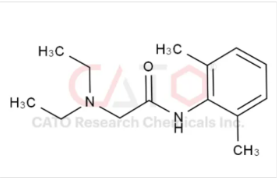 Lidocaine — molecular structure |
|
One Molecule, Two Sensitive Groups |
Lidocaine hydrochloride (C14H22N2O·HCl·H2O) splits structurally into two ends: Aromatic ring end — 2,6-dimethylaniline, linked via an amide bond → source of genotoxic impurity risk Aliphatic chain end — a diethylamino (tertiary amine) group → source of nitrosamine (NDSRI) risk
|
Spotlight One: 2,6-Dimethylaniline (Impurity A) IARC Group 2B carcinogen; classic ICH M7 "structural alert" — forms a DNA-reactive nitrenium ion via CYP450 N-hydroxylation NTP two-year study: induced nasal and liver tumors in rats Designated "Impurity A" in USP/EP/BP and in an FDA ANDA review (NDA 207962) — consistent across major regulatory systems ChP 2020: HPLC-limited to NMT 0.04% (injection); other impurities NMT 0.5%; total NMT 1.0%
|
|
Aromatic amine pathway
2,6-Dimethylaniline → CYP450 → nitrenium ion → DNA adducts → IARC 2B | | Tertiary amine pathway
Diethylamino → dealkylation → secondary amine → nitrosation → NDSRI |
|
Spotlight Two: Tertiary Amine & NDSRI Risk Post-2018 "sartan" NDMA recalls put tertiary-amine APIs under industry-wide scrutiny FDA/EMA: secondary, tertiary, and quaternary amines can all form nitrosamines under acidic + nitrosating conditions Tertiary amines carry lower direct risk than secondary amines, but can dealkylate to a secondary-amine intermediate, then nitrosate — lidocaine's diethylamino side chain falls into this category An N-nitroso-lidocaine reference standard is already available to support NDSRI risk assessment and method validation
|
|
Pharmacopoeial Requirements at a Glance |
USP, EP, and BP list 2,6-dimethylaniline as a named, individually controlled impurity (refer to current editions for exact limits). ChP 2020, for reference: |
Test | Method | Limit | 2,6-Dimethylaniline (injection) | HPLC, ChP 0512 | NMT 0.04% | Other individual impurities | HPLC, external standard | NMT 0.5% | Total impurities | HPLC | NMT 1.0% | Acidity | ChP 0631 | pH 4.0–5.5 |
|
CATO's Lidocaine Impurity Profile Solution |
Built around these two impurity classes, CATO offers a comprehensive lidocaine reference standard portfolio: |
CATO Research Chemicals · Dual ISO 17034 Accreditation (ANAB AR-2832 / CNAS RM0030) |
Product | Cat. No. | CAS No. | Notes | Lidocaine Hydrochloride | CP146261 | 73-78-9 | API reference standard | Lidocaine EP Impurity A (2,6-Dimethylaniline) | C4X-16791 | 87-62-7 | Genotoxic · IARC Group 2B | Lidocaine Impurity 13 | C4X-167913 | 79-04-9 | Process-related impurity | Lidocaine EP Impurity D | C4X-167915 | 7728-40-7 | Pharmacopoeial impurity | Lidocaine Impurity G | C4X-167936 | 42450-30-3 | Pharmacopoeial impurity | Lidocaine EP Impurity K/H HCl | C4X-167928 / C4X-167911 | 74634-46-5 / 50295-20-0 | Pharmacopoeial impurity | N-Nitroso-Lidocaine | C4X-167955 | – | NDSRI risk assessment | N-Nitroso-Lidocaine EP Impurity E | C4X-167959 | – | NDSRI risk assessment | Lidocaine-d6 HCl | C4X-167924 | – | Metabolic internal standard, LC-MS/MS | 3'-Hydroxylidocaine / 4-Hydroxylidocaine | C4X-167951 / C4X-167952 | 34604-55-2 / 39942-41-1 | Metabolite reference standard |
|
90+ additional impurities, metabolites, and isotope-labeled derivatives are available across the full lidocaine line. All products are manufactured under CATO's dual ISO 17034 accreditation (ANAB AR-2832 / CNAS RM0030), with complete structural confirmation data and full batch traceability. |
|
CATO Research Chemicals Inc. | standards@cato-chem.com | en.cato-chem.com |

 Wish list (0)